A Guide to Your Internal Family System: Managers, Firefighters, Exiles and Self
Human Beings are Beautifully Complex
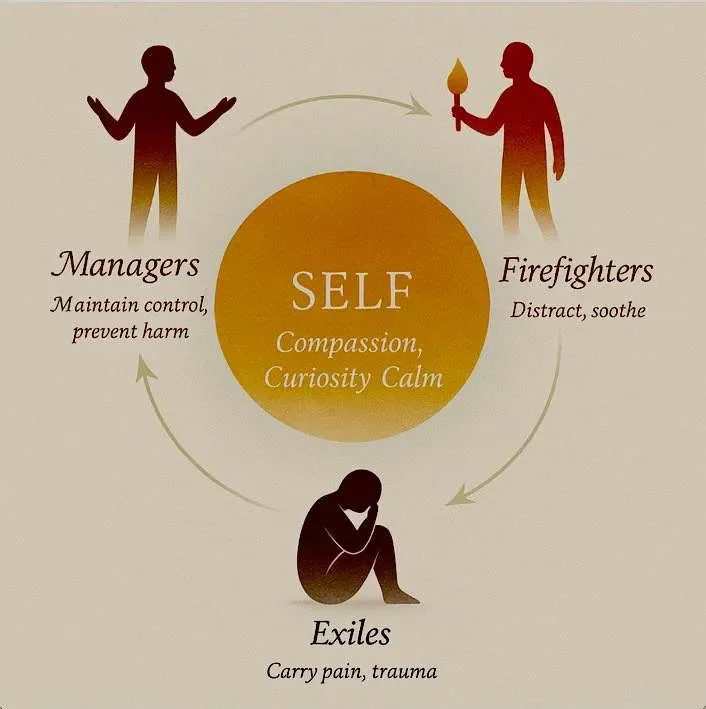
Have you ever been faced with a tough decision, and it feels like a dozen different voices inside all speak up at once? From the perspective of IFS, your internal system is made up of many parts, all organized around protecting you from pain. It’s normal that many parts of you would get activated by something important (or even not so important), each responding in the way it feels is best. If you’ve ever felt like you’re juggling a dozen versions of yourself, each one pulling in a different direction, then you know how noisy this can feel. Maybe it’s hard to even hear yourself think. You might wonder, Which of these is the real me? Why do I feel so divided inside?
IFS, or Internal Family Systems, provides a way of conceptualizing these internal struggles. Vulnerable parts that hold pain get exiled from your system, and protective parts work really hard to keep the pain away, and stop the pain when it gets triggered. Beneath all of these parts is your core Self: the purest, best version of yourself. This guide will help you understand how internal family systems are organized, and outlines the roles of each major category of parts. You’ll begin to understand how Manager and Firefighter parts both protect Exiles, but in different ways, and get a sense of what we mean when we say Self or Self-energy, and why it’s the key to your healing. Let’s take a closer look at Managers, Firefighters, Exiles and Self, and how they all work together in your internal system.
TL;DR: Meet Your Internal Family System
This guide will introduce the way we conceptualize how parts are organized in your internal system from the perspective of an IFS therapist in NH. Want to get to know each type of part more intimately, and understand its role in your system? These companion blogs offer a deeper dive into each role:
Managers: The Parts That Keep It All Together

We love our manager parts. Often, manager parts feel the most like “you”: they are driven, organized, and responsible. Managers get a lot of external validation and praise: they are responsible for your good grades, your promotion at work, or why your business venture is so successful. They get you out of bed in the morning, keep you healthy, track your schedule and your to-do lists. They get things done and help you navigate daily life in a way that keeps you safe, successful, and in control.
Managers are usually proactive, and future-focused. They anticipate threats (emotional or otherwise) and do whatever they can to prevent them. Managers are constantly scanning, working, running in the background of your life, around the clock.
Beneath their control and confidence, managers feel the weight of their constant workload. They never get a break, and don’t believe that it would be safe to rest. They know how deeply you’ve been hurt, and have taken up the mantra: “never again.” They will work tirelessly to protect you from feeling the way you did before.
Managers have also seen what can happen when the vulnerable parts of you get triggered, and firefighters step in to douse the flames. They’re in constant battle with the firefighters, who they see as overreacting and chaotic. They don’t hesitate to make their opinions about your firefighter behaviors known, berating you when they act up. They try really hard to keep other parts in line, but it’s a lot of parts to manage, and they get frustrated when it doesn’t work. It’s too big a job. It’s exhausting.
Managers are often the parts that bring people into therapy in the first place. They’re tired of having things fall apart when they’re trying desperately to hold everything together, and they know something has to change.
Since managers are so often blended with us, they sometimes are surprised to learn that they are not you. It can take some time to build trust, to allow you to do the deeper work. However, when wounds have been healed and managers finally feel safe enough to rest, the relief can be palpable. Want to learn more about managers, and how they help you? Read: Meet and Greet—Managers.
Firefighters: The Parts That Step In When the Alarm Bells Ring

Firefighters are the parts that soothe, distract, and numb when something touches your shame, your pain, or those beliefs that lurk in the background: I’m not good enough. I’m unlovable. If anybody really knew me, they’d walk away.
While Managers are proactive, Firefighters are reactive. They are present focused. When your system feels overwhelmed, and pain breaks through despite your manager’s carefully maintained walls, Firefighters rush in. Their only goal is to get you out of pain right now.
This could look like numbing out with food, binge-watching shows, scrolling endlessly, diving into work, or having a drink. In more extreme moments, it might show up as self-harm, rage, or suicidal thoughts. When a house is on fire, a firefighter will break the door down to get inside, and even break down walls if necessary. The goal is to put out the fire; any collateral damage is incidental, irrelevant, and certainly not something he’s going to worry about in the moment. In your inner system, firefighters aren't concerned with long-term consequences; they're concerned with stopping the emotional fire that's raging inside.
While their methods might seem destructive or confusing, their motivation is love. Firefighters are deeply loyal. They’re trying to protect you from the unbearable, and they’ll do whatever it takes to pull you out of emotional distress.
These parts are often met with shame and judgment. Family and friends get hurt and angry. Society sees them as bad habits, vices, things that you can overcome with a positive attitude and a bit of willpower. Inside, the familiar shame cycle starts: What’s wrong with you? You know better, how could you do this again?
In IFS, we get curious. What pain are they protecting you from? What are they worried would happen if they didn't show up? If they didn’t have to protect you from pain, what would they rather be doing? To learn more about these parts, read: Meet and Greet—Firefighters.
Exiles: The Parts That Hold Your Deepest Pain

Exiles are the parts of you that carry your pain, your shame, and your deepest fears. They are your inner children. They hold the story of your traumas, and core beliefs about your worth and safety. They’re often young, sensitive, and deeply vulnerable. These are the parts that internalized messages like “I’m not enough,” “I’m not worthy of love,” or “The world isn’t safe.”
Because their pain is so overwhelming, the system makes the decision to “exile” them, pushing them down, locking them away, and keeping them out of sight. Your Managers try to prevent anything that might trigger these parts. Your Firefighters step in when the pain leaks through. But the Exiles are still there, still hurting, still longing for connection and care.
Exiles are more than just the pain that they carry. They also hold beautiful, valuable qualities that get locked away with the pain. They are frozen in time, stuck in the past, forgotten and neglected. It can be easy for protectors to want to leave them there. Why think about those painful memories? The past is the past. Move on. The trouble is, the energy of those parts is still there, still real, still present, and in trying to keep it contained, the good gets blocked right along with the bad.
When we meet these parts in therapy, it’s not about reliving your trauma. It’s about witnessing. Listening. Allowing these parts to tell their story, sometimes for the first time. And when that happens, something extraordinary occurs: these young parts begin to heal. They release burdens. As they let go of fear, shame, and despair, they reconnect with the qualities they were forced to hide away, like joy, playfulness, and wonder. Want to know more about exiles, and how their healing can transform your system? Read: Meet and Greet—Exiles.
Self: The Calm, Compassionate Core of Who You Are

If all of these parts are just that—parts—you might wonder, then who is the real me?
IFS teaches that at your core, beneath all the roles and reactions, there is a Self. This Self is not a part, but a presence: a wise, grounded, compassionate inner leader that can help your whole system come into balance. If parts are the stars and constellations, Self is the sky.
Self-energy is calm, curious, connected, confident, compassionate, creative, courageous, and clear. It’s also patient, persistent, present, playful, and full of perspective.
The presence of Self-energy in your system is a spectrum: at one end, parts completely hijack your system without your awareness; at the other, leading from Self with an awareness of and consideration for all the parts of your system. It’s not all or nothing. Parts are crucial, valuable, and make you who you are. The aim is never to get rid of parts in favor of Self, but rather for parts to be in relationship with Self, and to benefit from the care and leadership of Self, even while Self benefits from the skills and feedback of each part.
The more you get to know your parts, the more spaciousness opens inside for Self energy to shine through. Self energy is the healing energy that makes this work possible. When Self leads, there is more inner harmony. Some people notice Self-energy when they connect with nature, or through creativity or movement. Interested to learn more about Self, and how to lean into it? Read: Who is the Real “You”?
Self to Part Connection: How Healing Happens in IFS

The goal in IFS therapy is real, transformational healing, so that you no longer have to carry the weight that you’ve carried for so long. We’re not here to analyze your past, learn coping strategies, or manage your impulses. Healing in IFS doesn’t come from a therapist giving you insight or advice. It comes from you, with Self-energy, connecting directly with your parts.
Since the healing power of IFS comes from your Self connecting with your parts, one of the most important roles of your therapist is to discern how much Self energy is present. Parts can’t heal other parts. Once you’ve decided on a part to get to know, we ask other parts to open enough space to connect with that part. This is especially important when other parts in your system don’t think too highly of the part in question (which is quite common). Think of it this way: let’s say that you’re sitting across from somebody having tea, and they are asking you questions and trying to get to know you. Now imagine that sitting right next to them is someone who you know doesn’t like you very much. How likely are you to feel safe enough to open up and share about your hopes and fears? Yeah. Not likely. This is why asking for space from other parts in your system is so important. As an IFS therapist in NH, I’m constantly asking questions to determine whether Self is relating to the target part, or whether another part is in the room.
I’ll ask:
How do you feel toward that part of you?
As you listen to what the part is sharing, does that make sense to you?
How open is your heart toward the part?
What does the part see when it looks at you?
If another part is present, we ask it to give space. If it can’t, or won’t, it’s for a very good reason. We slow down, turn toward the part, and address its concerns. If the part feels like its concerns have been sufficiently addressed, it is usually willing to allow you to proceed. Otherwise, it becomes our new target part, and we spend time really getting to know it so that it can trust you.
You’ll learn to get to know the parts that drive you to do things you’d rather quit doing, and understand their reasons. You’ll get their permission to meet your inner children, and give them the love and care that they have needed for a long time. You’ll witness their stories, until they feel truly seen, and fully understood. You’ll help them come out from the places in the past where they’ve been stuck, and release the burdened feelings and beliefs that they’ve been carrying. You’ll have the honor of seeing them invite in qualities that were lost or covered over by your trauma, and transform in freedom. You’ll invite the protective parts of your system to see their transformation, add their own burdened beliefs and feelings to the fire, and soak in the freedom to take one new, preferred roles in your system. This is just a taste, of course. For an in-depth look at what IFS is and how it works, check out A Gentle Guide to Getting Started with IFS.
Learning to Love Your Inner System

IFS therapy feels kind of like a guided meditation; an inner journey of discovery and compassionate connection. We notice how parts show up in your body, and you’ll become more in tune with your inner experience. You’ll learn to pay attention to what your thoughts, feelings and sensations are trying to communicate.
The more you get to know your parts, the more you realize: you are beautifully complex. You are not broken, or too much, or impossible to understand. Your parts all make sense when you know their stories, and they are able to soften when the deeper wounds begin to heal.
As an IFS therapist in NH, I have the honor of witnessing the relief and healing that can only happen when parts feel truly seen. I’ve had the privilege of watching clients connect with their inner worlds in ways that bring relief, clarity, and peace. Parts become free of their extreme roles, and can add value to your life in new ways. Clients begin to feel like themselves again, and can turn towards their inner experience with softness, perhaps for the first time. When they find compassion within, it has the power to transform their lives.

Melanie is an IFS therapist who helps high functioning adults heal from the impact of childhood trauma and reconnect with their inner sense of calm and self leadership. Her work blends depth, warmth, and curiosity to support clients in developing compassionate relationships with all parts of themselves.
Specialties include IFS therapy, childhood trauma healing, and helping people get unstuck. For more about Melanie and how she works, click here.
